
Table of Contents
- Is Expensive Clothing Actually Better? What the Evidence Says
- Price vs. Quality: Where the Money Actually Goes
- How to Identify High Quality Clothing in the Store
- The Cost Per Wear Calculation That Changes the Math
- Fit, Comfort, and Why a $25 Tee Can Beat a $120 One
- Where Quality Gains Level Off: Price Tiers Explained
- Care, Repair, and Making Any Garment Last Longer
- Frequently Asked Questions
Last Updated: October 21, 2026
Is Expensive Clothing Actually Better? What the Evidence Says
No, expensive clothing is not automatically better. In tests of jeans, T-shirts, and hoodies, high-end fashion was reported to be no more durable than lower-priced fashion, according to Forbes' coverage of a clothing durability study.
The assumption survives because price is the easiest quality signal to read in a store. Judging a seam or fabric weight takes knowledge most shoppers were never taught.
Below, we break down where your money actually goes, how to spot real quality in person, and when paying more genuinely pays off.
Price vs. Quality: Where the Money Actually Goes
Most of an expensive garment's price has nothing to do with how it's made. A price tag covers materials, labor, construction, marketing, brand positioning, retail overhead, and profit margin.
Branding premiums are real and substantial. Luxury houses spend heavily on advertising, celebrity campaigns, and store design, and that spending lands in the price. You are partly paying for the name stitched inside the collar.
The durability research backs this up. A University of Leeds study reported by Business Insider found that low-cost clothing might last as long as, or longer than, pricier designer pieces. Price and longevity, in other words, are correlated far more loosely than most shoppers assume.
How to Identify High Quality Clothing in the Store
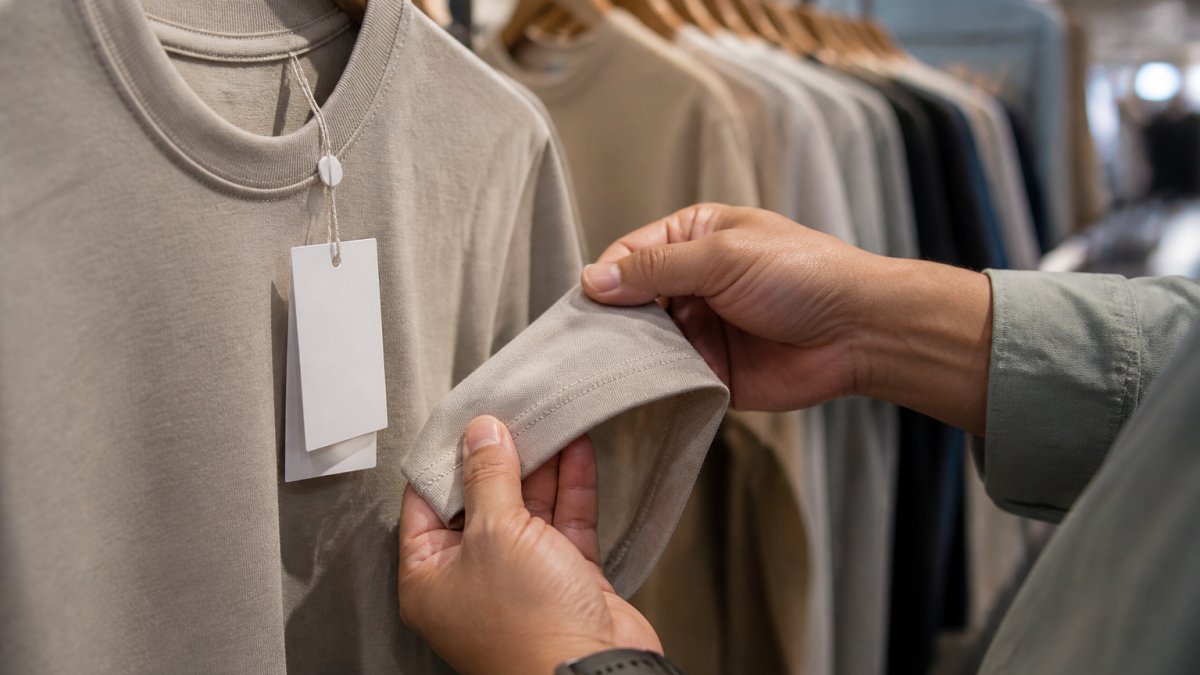
Quality is measurable if you know what to check. You can assess most garments in under two minutes using four checks: fabric content and weight, seam construction, stitch density, and hardware or print quality.
Fabric and Material Checks
Natural fibers like cotton, linen, and wool generally breathe better and age more gracefully than synthetics, though synthetics add stretch and abrasion resistance. Fabric weight matters just as much: a 6 oz cotton tee holds its shape longer than a 4 oz one.
Hold the fabric to the light. If you can see through a tee that isn't marketed as sheer, expect it to thin out fast. Rub two layers together and check for immediate pilling.
Stitching, Seams, and Construction
Turn the garment inside out. Look for clean, dense stitching, no loose threads, and flat seams. Reinforced double-needle stitching at stress points, neck, sleeves, hem, signals a maker who expects hard wear.
A stretch-proof collar is another tell. Cheap tees develop a wavy, stretched neckline within months; a wide rib collar holds its shape. Print quality matters too: a cracked graphic usually means a thin application, not normal wear.
The Cost Per Wear Calculation That Changes the Math
The cost per wear calculation is the purchase price divided by the number of times you realistically wear the item. A $25 tee worn 50 times costs $0.50 per wear; a $120 tee worn 20 times costs $6.00.
That basic formula is where most advice stops, and where it is wrong, because purchase price is only one of four inputs. The full version is:
Net cost per wear = (purchase price + care and repair costs − resale or donation value) ÷ total wears before retirement
Each input moves the answer in a different direction, and expensive clothing only wins when the later inputs improve faster than the price rises.
Input 1: Purchase Price
This is the number on the tag, and the only one shoppers reliably know. A $25 basic tee, a $27.50 heavyweight tee, a $120 premium tee, and a $400 designer piece all start here. On its own, price tells you nothing about value.
Input 2: Realistic Wear Count
Wear count is the input people inflate most, wardrobe audits show people overestimate favorite-item wears by two to three times. Count actual wears: tally your five most-worn garments over the past year.
Fit and versatility drive this number more than price does. A $120 tee cut for a runway silhouette that you wear 12 times loses to a $25 tee that fits your shoulders and gets worn 60 times, before you count a single repair.
Input 3: Care, Repair, and Replacement
This is the input the simple formula ignores, and where cheap clothing often loses. A garment washed hot and tumble-dried can shrink, pill, and fade within a season; washed cold and air-dried, it may hold its shape for years.
Replacement frequency is the quiet killer. A $25 tee you replace twice a year costs $50 annually. A $60 tee that lasts three years costs $20 annually. The cheaper shirt is the more expensive habit.
XXX Tentacion "Revenge" Graphic Tee →
Input 4: Resale and Residual Value
Durable, timeless pieces hold value in the secondhand market in a way fast-fashion basics do not. A heavyweight cotton tee with clean construction and a classic cut can be resold or handed down; a thin, pilled tee usually cannot. Resale value narrows the net cost gap between a well-made mid-tier piece and a cheap one.

Worked Examples
| Garment | Price | Wears | Care/Repair | Resale | Net Cost Per Wear |
|---|---|---|---|---|---|
| Basic tee | $25 | 50 | $0 | $0 | $0.50 |
| Premium tee | $120 | 20 | $0 | $0 | $6.00 |
| Heavyweight tee | $27.50 | 80 | $5 | $0 | $0.28 |
| Designer piece | $400 | 30 | $0 | $80 | $10.67 |
| Cheap tee replaced twice a year | $25 × 2 | 100 | $0 | $0 | $0.50 |
| Mid-tier tee kept three years | $60 | 150 | $10 | $0 | $0.47 |
Read the last two rows together. The cheap tee and the mid-tier tee land within a few cents per wear, but the mid-tier tee required one purchase instead of six and stayed in rotation instead of being thrown out. Cost per wear is a tiebreaker, not a verdict; the garment you actually reach for wins.
Fit, Comfort, and Why a $25 Tee Can Beat a $120 One
Fit beats price almost every time. A garment that suits your body and style gets worn constantly; an expensive piece with a poor fit hangs in the closet.
Comfort follows the same logic. A heavyweight cotton tee with a relaxed fit often outperforms a designer piece cut for a runway silhouette.
This is why a well-made $25 tee can beat a $120 one.
Where Quality Gains Level Off: Price Tiers Explained
Quality improves with price up to a point, then flattens. Past roughly the mid-tier, extra dollars buy branding, exclusivity, and design rather than measurably better fabric or construction.
To answer it, compare like with like: hold the garment type constant, same category, cut, and color, then score each item on indicators you can check in a store or after a few washes.
The Measurable Indicators
These are the quality signals that show up in independent testing and in your own laundry:
- Fabric weight and composition. A 6 oz cotton tee is a different garment from a 4 oz one. Heavier knits resist thinning and hold shape longer; fiber content determines how the fabric breathes, pills, and ages.
- Shrinkage. Wash a new garment in the temperature you will actually use and measure before and after. Significant shrinkage changes fit and shortens useful life.
- Pilling. Rub two layers of fabric together, or wear and wash the item a few times, and check for surface fuzz and balls. Pilling is one of the fastest visible signs of fiber quality.
Score each garment on the same indicators and the tier picture becomes concrete instead of rhetorical.
What Each Tier Actually Buys
- Under $30: Basic construction; quality varies widely. The good items here are genuinely good, heavier knits, reinforced seams, wide rib collars, and the bad ones are thin, pilled, and short-lived. Inspect seams and fabric weight carefully, because price gives you almost no signal at this tier.
- $30 to $100: The sweet spot for construction and materials in everyday apparel. Reinforced stitching, heavier fabrics, and better collar construction become normal rather than exceptional. This is where the measurable indicators most reliably improve per dollar.
- $100 to $300: Diminishing returns on durability. Fabric and construction may improve modestly, but a growing share of the price goes to design, fit development, and brand positioning. The measurable gains are real but smaller than the price jump suggests.
- $300 and up: Mostly brand premium and status. Durability gains are minimal, and the durability research reported by Forbes' coverage of a clothing durability study found high-end garments no tougher than cheap ones. At this tier you are buying design, exclusivity, and the name inside the collar.
The Like-for-Like Test
Put two tees side by side, one from the under-$30 tier, one from the $100-plus tier, and run the same checks: fabric weight, seam density, collar recovery, print application, and wash behavior. A common pattern is that the mid-tier garment matches or beats the luxury one on most measurable indicators while costing a fraction as much. When that happens, the extra spend is buying something other than quality, and it is worth being honest about what that something is.
The practical takeaway: buy at the tier where measurable indicators stop improving, then let fit and care decide the rest. For most everyday apparel, that is the mid-tier, the range where heavyweight fabric and reinforced construction are normal rather than premium.
Care, Repair, and Making Any Garment Last Longer
Garment lifespan is decided as much by care as by construction. Wash cold, turn items inside out, skip the dryer when you can, and repair small damage early.
Care protects your cost per wear math.
Resale value matters too. Buying fewer, better pieces also counters the trend reported by Dutch Label Shop's 2026 fashion statistics, where consumers buy 60% more clothing than they did 15 years ago while keeping each item for about half as long.
At NEVERBASIC CLOTHING CO, we build around that idea: heavyweight cotton, reinforced stitching, and fits designed for daily wear. Our These Nuts Black Unisex max heavyweight short sleeve, for example, uses 7.5 oz USA cotton with double-needle stitching at the neck, sleeves, and hem, priced at $22.50. That's the tier where quality gains are real, without the brand premium.

Expensive clothing is not a shortcut to quality, and cheap clothing is not a guarantee of failure. The real challenge is judging construction, fit, and fabric before you spend.
Frequently Asked Questions
Does a higher price tag always guarantee better fabric?
No. A 2024 durability comparison of jeans, T-shirts, and hoodies reported by Forbes found high-end fashion was no more durable than lower-priced fashion, and a 2018 University of Leeds study reported that low-cost clothing could last as long as or longer than designer pieces. Price reflects branding, marketing, retail overhead, and distribution as much as materials. When you shop, check the fabric weight, fiber content, and stitching yourself instead of trusting the tag price as a quality signal.
How do I run a cost per wear calculation before buying?
Divide the purchase price by the number of times you realistically expect to wear the item. A $25 tee worn 50 times costs $0.50 per wear; a $120 tee worn 40 times costs $3.00 per wear. Be honest about frequency: a statement piece worn twice a year rarely wins the math. This calculation is the fastest way to tell whether expensive clothing actually earns its price for your wardrobe.
What are the primary indicators of high-quality clothing?
Look at fabric weight and fiber content first, then construction. Heavyweight cotton (around 6 oz./yd.² and up) holds its shape better than thin jersey. Check for reinforced double-needle stitching at the neck, sleeves, and hem, a stretch-proof collar, taped neck and shoulder seams, and clean seam finishes. These construction details predict garment lifespan far more reliably than the brand name on the label.
Can I find durable clothing without luxury pricing?
Yes. Durability comes from materials and construction, not price tier. A 100% cotton heavyweight tee with reinforced stitching can outlast a thinner designer piece at a fraction of the cost. Read the spec sheet: fabric weight in oz./yd.², fiber content, and stitching details. Independent testing reported by Forbes and the University of Leeds study both suggest paying more does not reliably buy longer life.