
Table of Contents
- Why High Quality Cotton Fabric Is Worth the Extra Look
- How to Identify Pure Cotton Fabric by Touch and Sight
- Fiber Length, Staple, and Combing: What Separates Long-Staple Cotton
- How to Test If Fabric Is 100% Cotton (Safely)
- Cotton Fabric Thread Count Explained (and Why GSM Matters More)
- Weave Consistency, Drape, and Visible Fabric Defects
- Cotton Fabric Durability and Shrinkage: What to Expect Over Time
- A Step-by-Step Buying Checklist for In-Store and Online
- Frequently Asked Questions
Last Updated: October 18, 2026
Why High Quality Cotton Fabric Is Worth the Extra Look
Most shoppers judge a t-shirt by the print. That is backwards. The fabric decides how the shirt feels on wash ten, whether it holds its shape, and whether you still wear it next year.
Two shirts can look identical on a hanger and behave completely differently after a month. One keeps its shape; the other pills, twists, and shrinks.
How to Identify Pure Cotton Fabric by Touch and Sight
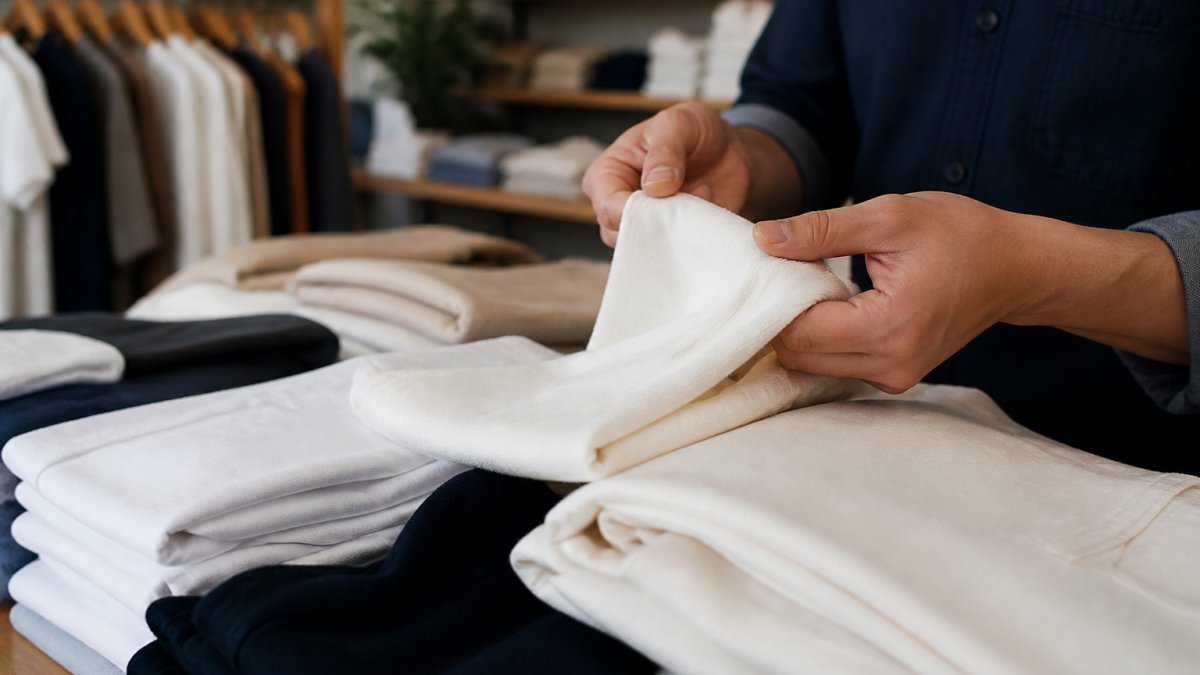
Pure cotton feels cool and slightly dry, not slick or waxy. Rub it between your fingers: real cotton has a soft, faintly grippy texture, while synthetics slide and feel soapy.
Hand Feel: Softness, Smoothness, and Warmth
Good cotton softness is not slickness. A high quality cotton shirt feels smooth but still has grip. Cheap cotton can feel scratchy at first, though some fades after a wash. The tell is whether the fabric feels dense and springy or thin and limp.
- Springy: squeezes and bounces back, a sign of decent yarn and weight
- Limp: collapses flat, often a thin, loosely woven fabric
- Warm quickly: cotton should feel cool for a second, then warm to your body heat
Surface Appearance: Matte Finish and Subtle Luster
Cotton should look matte with a faint, natural luster. High shine usually means a synthetic blend or heavy finish. Check for slubs (small thick spots in the yarn): a few are normal, but a fabric covered in them or with visible thin patches is not well made.
Fiber Length, Staple, and Combing: What Separates Long-Staple Cotton
Long-staple cotton is stronger, smoother, and pills less because longer fibers twist into a tighter yarn with fewer exposed ends. Short-staple cotton sheds fibers, creating pilling and a rougher hand over time.
Combed cotton has short fibers and debris brushed out before spinning, leaving a cleaner, stronger yarn. You cannot always see staple length on a label, but you can feel it: long-staple, combed fabric feels smoother and resists pilling.
How to Test If Fabric Is 100% Cotton (Safely)
The safest way to check fiber content is the care label plus a feel test. For more certainty, a small burn test on a loose thread or seam allowance can help, but only on a scrap, never on a garment you plan to wear.
The Burn Test: What It Can and Cannot Tell You
Cotton burns fast with a yellow flame, smells like burning paper, and leaves gray ash. Synthetic fibers melt, smell chemical, and leave a hard bead. Here is the catch: the test only works on a single loose thread, and it cannot detect blends reliably. It also tells you nothing about fiber length, weave quality, or construction.
Cotton Fabric Thread Count Explained (and Why GSM Matters More)
Thread count is the number of threads woven per square inch, counting both warp (lengthwise) and weft (crosswise) yarns. A "200 thread count" sheet has roughly 100 warp and 100 weft threads per inch. That sounds precise, but the number is easy to inflate and misread, making it the weakest single spec you can buy on.
Why a Higher Thread Count Is Not Automatically Better
Thread count only means something when you know the yarn size. Fine yarns let you pack more threads per inch without stiffness.
A common pattern is multi-ply counting: a mill counts each ply of a two-ply yarn as a separate thread, so a 200-count two-ply fabric gets marketed as 400. The number is just measuring something different than you assumed.
Yarn Count and Staple Length: The Specs That Actually Predict Quality
Yarn count describes how fine the yarn is, usually expressed as a number where higher means finer (for example, a 40s or 60s single yarn). Finer yarns need longer staple fibers, so yarn count and staple length are linked.
Staple length is rarely printed, but you can infer it. Long-staple cotton (often marketed as Supima, Pima, or Egyptian, though the names are not tightly regulated at retail) spins into smoother yarn with fewer protruding ends, so it pills less and feels silkier.
GSM and Ounces per Square Yard: Reading Fabric Weight
GSM (grams per square meter) measures fabric weight; in the U.S. you will also see ounces per square yard (oz./yd.²).
- Lightweight (roughly under 150 GSM / under 4.4 oz./yd.²): sheer, cool, best for summer basics and linings; prone to see-through wear
- Midweight (roughly 150-200 GSM / 4.4-5.9 oz./yd.²): the everyday range for t-shirts and shirting; balances drape and durability
- Heavyweight (roughly 200-280 GSM / 5.9-8.3 oz./yd.²): structured, opaque, holds shape and print; can feel stiff until broken in
Weight is not a quality score by itself. A 220 GSM tee made from short-staple cotton can still pill and twist; a 160 GSM tee from long-staple combed yarn can outlast it. Weight predicts opacity, structure, and warmth.
XXX Tentacion "Revenge" Graphic Tee →
How to Compare Specs Without a Lab
You will rarely get all four numbers at once. Use what is disclosed to set expectations, then confirm with your hands. A fabric that claims long-staple cotton and midweight GSM but feels thin and limp is a mismatch worth walking away from. No spec sheet is not automatically bad, plenty of good mills sell on feel, but then you are relying entirely on the tactile checks above.
Weave Consistency, Drape, and Visible Fabric Defects
Weave consistency is where cheap fabric gives itself away fastest. Backlight the fabric and scan the grid: well-woven cotton has an even, regular interlacing with no visible gaps, wandering threads, or thin patches that glow brighter than their neighbors. Then let it hang from one hand: good cotton drapes with weight, falling in soft folds rather than sticking out stiffly or clinging to itself.
Inspecting the Weave: A Repeatable Scan
Work in a fixed order so you do not miss anything:
- Backlight the fabric. Look for thin spots, skipped threads, and gaps where the weft did not cross cleanly.
- Check the grain. Warp and weft should run straight. A fabric cut off-grain will twist and hang crookedly after washing.
- Look for slubs and neps. A few small thick spots are normal in natural cotton. Clusters of them, or long slubby streaks, point to uneven yarn.
- Check for pulled threads and snags. These are handling and finishing defects, not fiber defects, and they predict where the fabric will fail first.
- Compare color across the piece. Patchy dye, shading at the fold lines, or a visible difference between the front and back of the fabric signals poor dye penetration.
Construction and Finishing Defects Most Shoppers Miss
Weave is only half the story. How the fabric is cut, sewn, and finished decides whether it survives real wear.
- Selvages: the finished edges should be tight and clean, not fraying or puckered. A wavy or distorted selvage often means the fabric was pulled off-grain during finishing.
- Print alignment: on printed cotton, the pattern should line up across seams. Misalignment at the side seam or center front is a cutting-room defect, not a design choice.
- Skipped stitches and loose seams: run a finger along the inside seam and tug gently. Skipped stitches, loose thread tails, and uneven stitch length are the first things to fail.
Drape, Recovery, and What They Tell You
Drape is the fabric's ability to fall in soft folds under its own weight. Hold a corner and let the rest hang. Good cotton falls with a little momentum and recovers when you bunch it and release.
A quick recovery test: crumple a corner in your fist for a few seconds, release, and smooth it once. Quality cotton relaxes back with a few soft creases.
A Quick Defect Checklist
- Uneven dye or patchy color
- Pulled threads or snags
- Thin, see-through patches under backlight
Run the scan in order and stop at the first serious defect. A single skipped thread is fixable; a fabric that fails the backlight and grain checks will not improve with washing.
Cotton Fabric Durability and Shrinkage: What to Expect Over Time
Expect some shrinkage from 100% cotton, especially on the first wash. Preshrunk cotton shrinks far less. Durability comes down to fiber length and weight: long-staple, heavier fabric resists pilling, holds color, and keeps its shape through repeated washing.
A common mistake is blaming a shirt for shrinking when hot water and high heat did the damage. For example, our XXX Tentacion "Revenge" Graphic Tee is made in the USA from 6.1oz 100% preshrunk cotton, designed for ultimate comfort and a heavyweight feel.

A Step-by-Step Buying Checklist for In-Store and Online
Use this checklist in a store or when unboxing an order at home. It takes about a minute and catches most quality problems before you commit.
| Check | What to Look For | Why It Matters |
|---|---|---|
| Feel | Springy, smooth, cool to touch | Signals decent yarn and weight |
| Surface | Matte, faint luster, few slubs | Rules out heavy synthetic blends |
| Weave | Even grid, no thin spots | Shows consistent construction |
| Weight | Midweight or heavier GSM | Predicts durability and opacity |
| Drape | Soft folds, moves with weight | Confirms good fiber quality |
| Seams | Straight, tight, even stitching | Catches finishing defects |
| Label | Combed or long-staple cotton | Confirms better fiber prep |
Run the checklist in order. If a shirt fails the feel and weave checks, stop there. No label claim rescues a thin, uneven fabric.
Frequently Asked Questions
How can I identify pure cotton fabric quickly in a store?
Rub the fabric between your fingers and check for a soft, matte surface with a slight warmth rather than a cool, slick feel. Pure cotton wrinkles when you squeeze it and springs back slowly. Look at the label for 100% cotton and check the weave for even, tight stitching. A quick visual pass plus a touch test takes under a minute and rules out most polyester blends before you head to the fitting room.
Does a higher thread count mean better cotton fabric?
Not necessarily. Thread count only measures how many threads are woven per square inch, and brands can inflate it by counting multi-ply yarns. A 200 thread count long-staple cotton can feel smoother and last longer than a 600 thread count short-staple fabric. Pair thread count with fabric weight in GSM and fiber length to judge high quality cotton properly. For everyday tees, a 6 oz. fabric with even weave is a stronger signal than a big thread count number.
How can you tell if cotton fabric will shrink?
Check the label for preshrunk or prewashed language, which means the fabric was treated before sewing to reduce shrinkage. Unwashed 100% cotton can shrink 3-5% after the first wash. Garment-dyed and preshrunk tees, such as our "These Nuts" Garment-dyed heavyweight cotton tee, hold their size better. When shopping online, look for preshrunk in the spec list and wash cold, then tumble low, to keep shrinkage minimal over time.
What should high-quality cotton feel like?
It should feel soft and smooth without a slick or plastic coating, with enough weight to drape rather than cling. High quality cotton has a matte finish and a subtle luster, not a shiny surface. Squeeze it and it wrinkles naturally, then relaxes. Rub two layers together and you should hear little friction. Thin, scratchy, or overly stiff fabric usually signals short-staple fibers, heavy sizing, or a synthetic blend.
Finding a shirt that survives real wear should not be a gamble. At NEVERBASIC CLOTHING CO, we build our graphic tees from heavyweight, preshrunk 100% cotton so they keep their shape, hold their print, and last past the trend cycle. Browse our latest arrivals and choose a tee that is anything but basic.